Market Trends & Analysis
Stay up to date with major market trends in the Los Angeles, Inland Empire, Las Vegas, and Reno market sectors with data as reported by CoStar, along with key indicators.
2Q26 Southern California Quarterly Newsletter
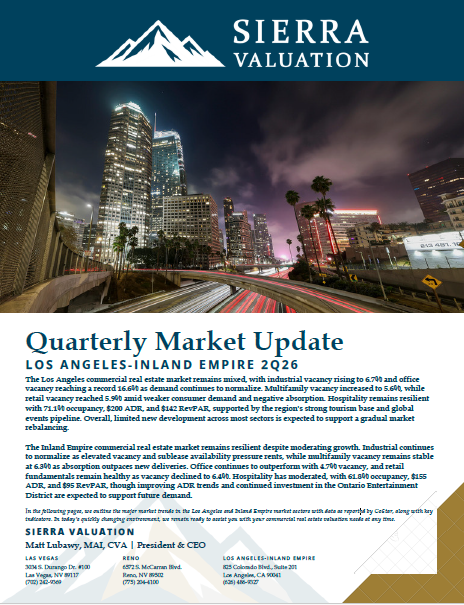
The Los Angeles commercial real estate market remains mixed, with industrial vacancy rising to 6.7% and office vacancy reaching a record 16.6% as demand continues to normalize. Multifamily vacancy increased to 5.6%, while retail vacancy reached 5.9% amid weaker consumer demand and negative absorption. Hospitality remains resilient with 71.1% occupancy, $200 ADR, and $142 RevPAR, supported by the region's strong tourism base and global events pipeline. Overall, limited new development across most sectors is expected to support gradual market rebalancing.
The Inland Empire commercial real estate market remains resilient despite moderating growth. Industrial continues to normalize as elevated vacancy and sublease availability pressure rents, while multifamily vacancy remains stable at 6.3% as absorption outpaces new deliveries. Office continues to outperform with 4.7% vacancy, and retail fundamentals remain healthy as vacancy declined to 6.4%. Hospitality has moderated, with 61.8% occupancy, $155 ADR, and $95 RevPAR, though improving ADR trends and continued investment in the Ontario Entertainment District are expected to support future demand.
2Q26 Nevada Quarterly Newsletter
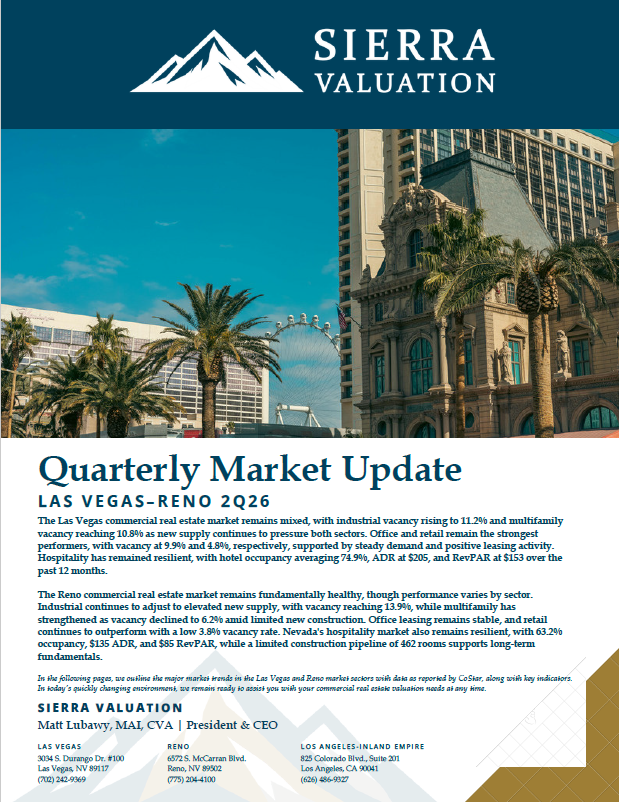
The Las Vegas commercial real estate market remains mixed, with industrial vacancy rising to 11.2% and multifamily vacancy reaching 10.8% as new supply continues to pressure both sectors. Office and retail remain the strongest performers, with vacancy at 9.9% and 4.8%, respectively, supported by steady demand and positive leasing activity. Hospitality has remained resilient, with hotel occupancy averaging 74.9%, ADR at $205, and RevPAR at $153 over the past 12 months.
The Reno commercial real estate market remains fundamentally healthy, though performance varies by sector. Industrial continues to adjust to elevated new supply, with vacancy reaching 13.9%, while multifamily has strengthened as vacancy declined to 6.2% amid limited new construction. Office leasing remains stable, and retail continues to outperform with a low 3.8% vacancy rate. Nevada's hospitality market also remains resilient, with 63.2% occupancy, $135 ADR, and $85 RevPAR, while a limited construction pipeline of 462 rooms supports long-term fundamentals
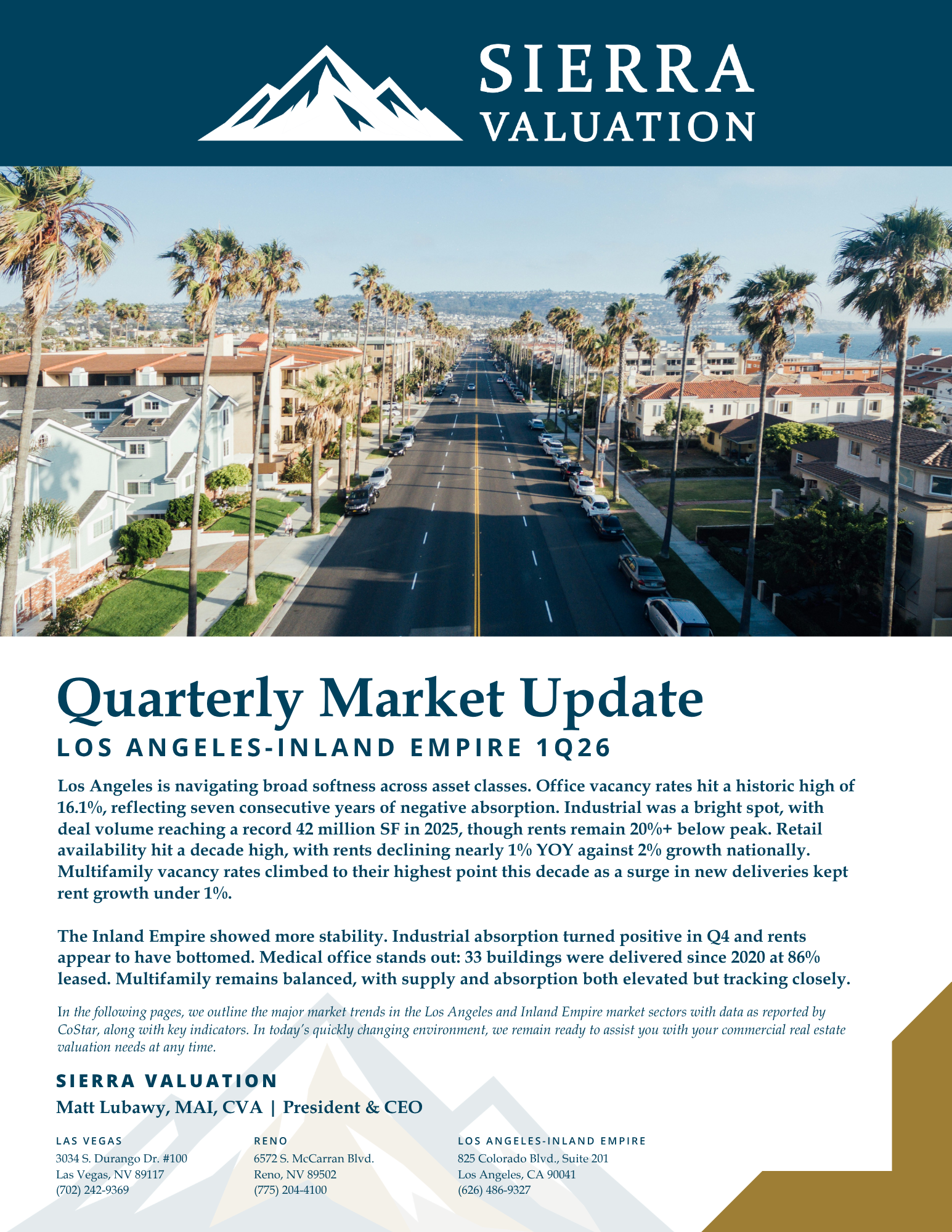
1Q26 Southern California Quarterly Newsletter
Los Angeles markets are seeing declining rents and rising vacancies across most asset classes. Office vacancy hit a record 16.5%, outpacing the 14.0% national average, while retail availability reached a decade-plus high of 6.3% with rents declining 0.7% year-over-year. Industrial rents are down 20%+ from peak, though the pace of decline is moderating. Multifamily holds up relatively well at 5.7% vacancy versus 8.5% nationally, with the Olympics and FIFA World Cup set to drive hospitality demand in the coming years.
The Inland Empire shows more resilience. Industrial absorption turned positive for two consecutive quarters and rents appear to have bottomed. Office vacancy sits at just 4.8% - well below the national average - though rents run 40% below Los Angeles. Multifamily vacancy has held steadily between 6% and 7%, with modest rent growth expected to accelerate gradually through 2027.
1Q26 Nevada Quarterly Newsletter
Las Vegas industrial vacancy has climbed to 11.3%, well above its 7.6% historical average, with rent growth near flat. Multifamily is the clearest pressure point at 10.5% vacancy with several years of flat-to-negative rent growth - though supply easing should help through year-end. Office and retail are bright spots, with office among the tightest major markets nationally and retail near a 15-year low of 4.9%. Hospitality is struggling, with RevPAR down 5.7% and transaction volume below its average.
Reno industrial vacancy surged to 13.7% on the back of 6.0 million SF of new supply. Multifamily and retail tell a different story: multifamily vacancy compressed to 6.8% with rents up 4.0% year-over-year, and retail tightened further to 3.7%. Office remains well below national benchmarks at 7.4% vacancy. Hospitality showed mixed signals, with RevPAR up 3.9% but ADR declining.
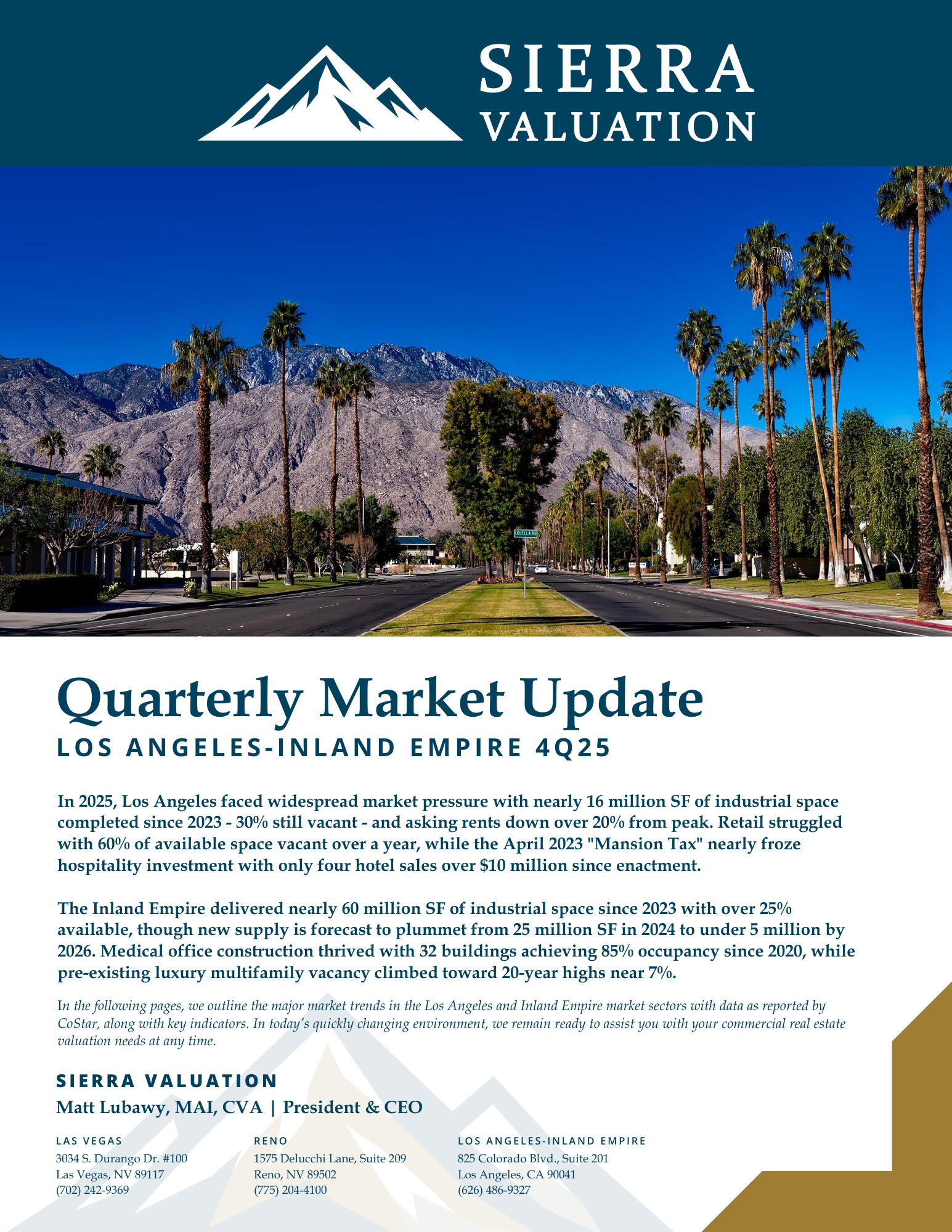
4Q25 Southern California Quarterly Newsletter
In 2025, Los Angeles faced widespread market pressure with nearly 16 million SF of industrial space completed since 2023 - 30% still vacant - and asking rents down over 20% from peak. Retail struggled with 60% of available space vacant over a year, while the April 2023 ”Mansion Tax” nearly froze hospitality investment with only four hotel sales over $10 million since enactment.
The Inland Empire delivered nearly 60 million SF of industrial space since 2023 with over 25% available, though new supply is forecast to plummet from 25 million SF in 2024 to under 5 million by 2026. Medical office construction thrived with 32 buildings achieving 85% occupancy since 2020, while pre-existing luxury multifamily vacancy climbed toward 20-year highs near 7%.
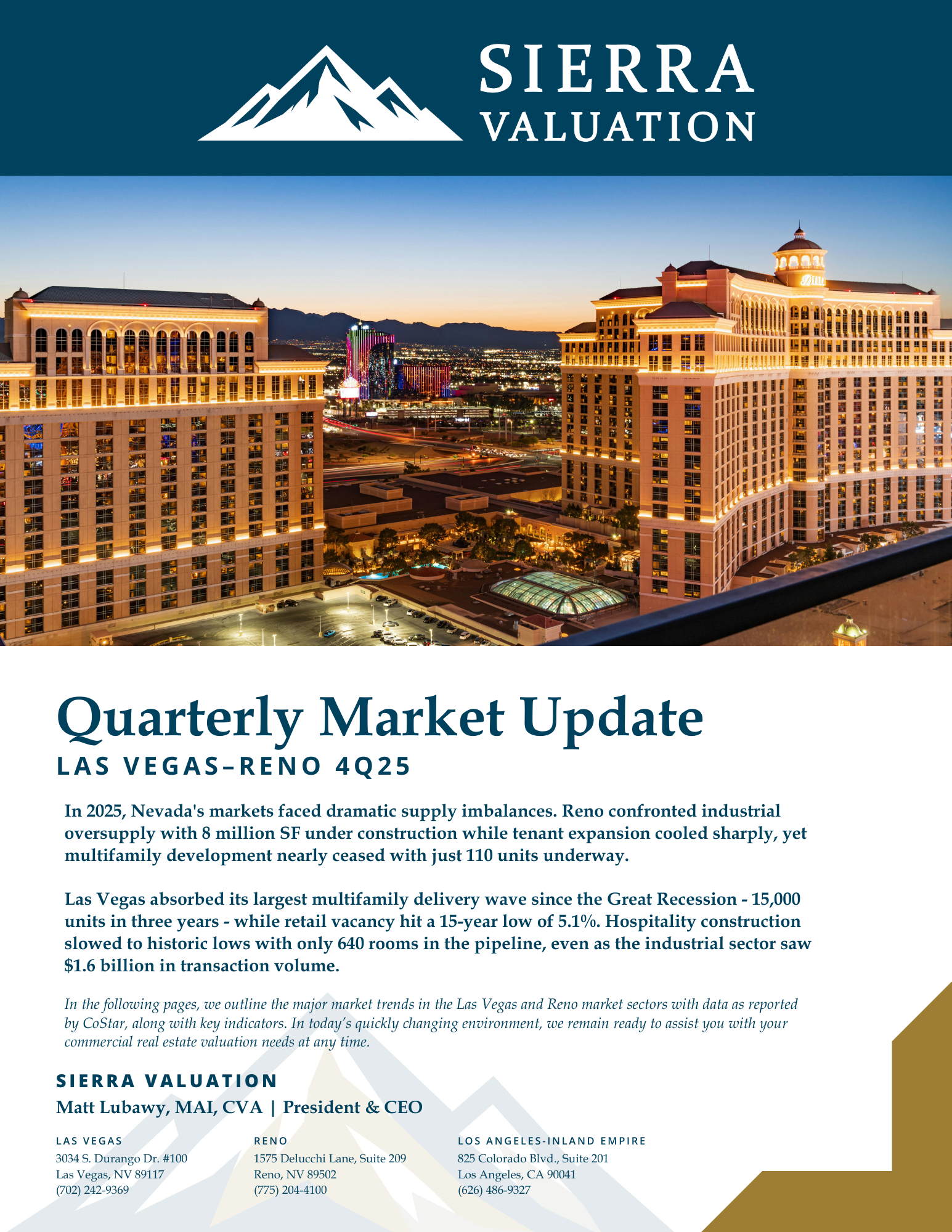
4Q25 Nevada Quarterly Newsletter
In 2025, Nevada's markets faced dramatic supply imbalances. Reno confronted industrial oversupply with 8 million SF under construction while tenant expansion cooled sharply, yet multifamily development nearly ceased with just 110 units underway.
Las Vegas absorbed its largest multifamily delivery wave since the Great Recession - 15,000 units in three years - while retail vacancy hit a 15-year low of 5.1%. Hospitality construction slowed to historic lows with only 640 rooms in the pipeline, even as the industrial sector saw $1.6 billion in transaction volume.
3Q25 Southern California Quarterly Newsletter
In Q3 2025, Los Angeles and Inland Empire commercial real estate markets exhibited contrasting trajectories. Over the quarter, Los Angeles confronted widespread sector challenges with vacancies, with industrial climbing to 6.5%, office space remaining stubbornly elevated at 16.0%, and multifamily reaching decade highs at 5.3%. Hospitality fundamentals remained strong with top-tier occupancy and ADR performance.
Meanwhile, the Inland Empire demonstrated bifurcated conditions across sectors: a robust office market tightened vacancy rates to 4.9%, and multifamily absorption was steady. Industrial availability expanded to 11.8% and retail space availability climbing over 100 basis points from decade-plus lows.
3Q25 Nevada Quarterly Newsletter
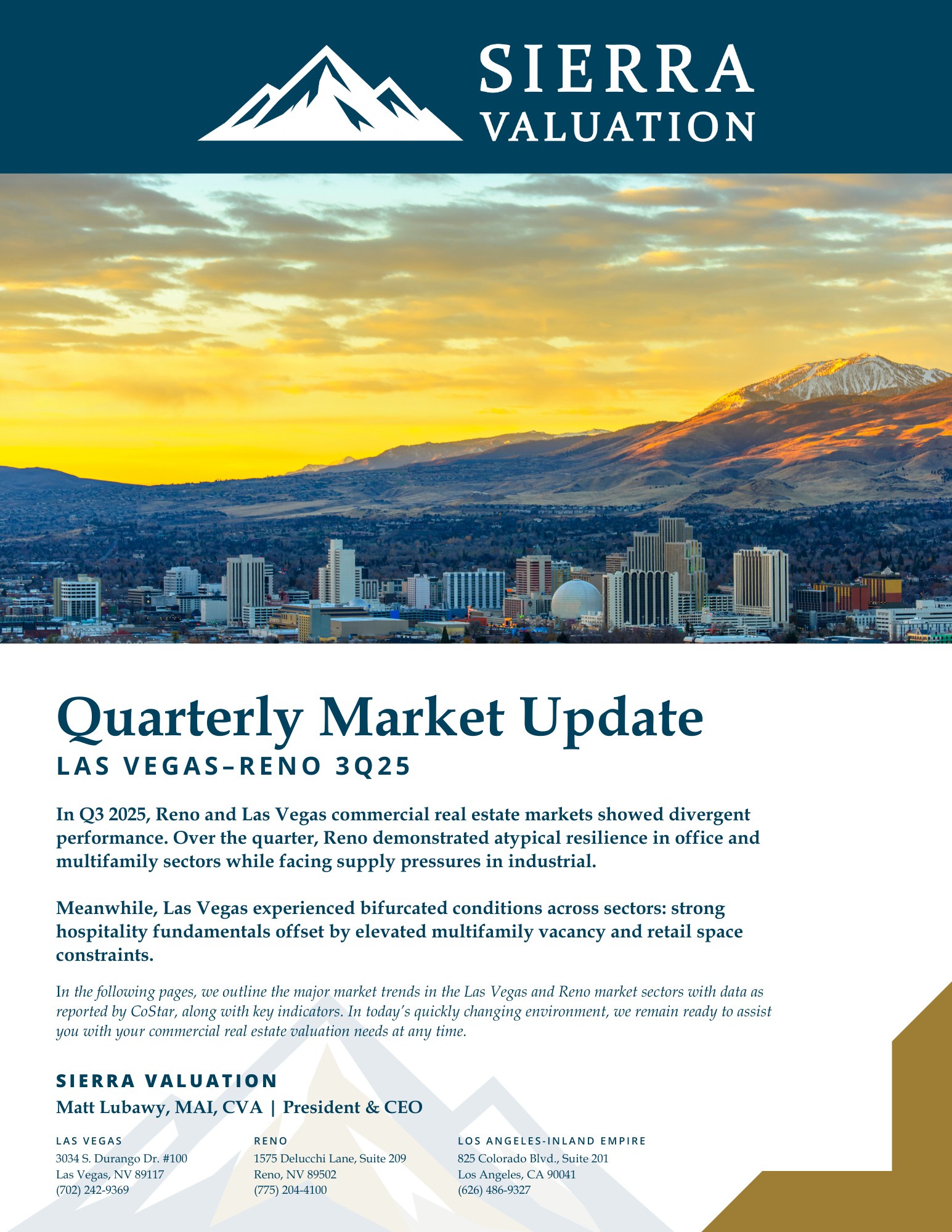
In Q3 2025, Reno and Las Vegas commercial real estate markets showed divergent performance. Over the quarter, Reno demonstrated atypical resilience in office and multifamily sectors while facing supply pressures in industrial.
Meanwhile, Las Vegas experienced bifurcated conditions across sectors: strong hospitality fundamentals offset by elevated multifamily vacancy and retail space constraints.